
Feb 2025 Unveiling Event at the Crown and Treaty

VIP guests of the unveiling event at the Crown and Treaty

The moment of the unveiling, led by MP Danny Beales and Judge Rupert Malo

Artist Misha Farris

Preparing for the unveiling

Giving the talk on the research and creation of the 3d Model of the Original Treaty House

Mayor Colleen Sullivan, opening the unveiling event

Judge Rupert Mayo, the last Recorder of Northampton

Danny Beales, MP for Uxbridge in the UK Parliament

High Sheriff of Northampton, Amy Crawfurd

With Artist Misha Farris and her artwork of the Original Treaty House

Guests talking after the event

Talking after the unveiling event

Our commemorative water flasks for the 380th Anniversay of the Peace Treaty Negotiations at Uxbridge

Having some fun--these are the stickers we had made for the gift bags
Historical Analysis of the Original Treaty House

2021 Uxbridge Satellite View

Annotated 2021 satellite view
Annotated satellite view of the Western edge of Uxbridge

Original Treaty House and twin gatehouses superimposed on 2021 satellite view

1775 image scaled and matched to modern image (with reference lines)

Detail view of original intersection of center span walls

Modern Treaty House image overlaid with intersection of original center span and roof

The modern octagonal turret was not present in the 1775 image

Comparison of modern building and historic image
Analysis of floors and location of original windows around the former interior staircase

Photoedited backside of the current wing illustrating original windows and location of the interior staircase

Footprint of the Surviving Treaty House

The footprint of the surviving wing showing how the center span connected in an "offset join"

Analysis of Star Chamber image showing probable size of its large square table
Analysis of treaty table dimensions

Western boundary of Uxbridge in 1825

Excerpt from 1825 map of Uxbridge showing remaining part of the original road around the Treaty House property

1796 grounds sketch excerpt showing single remaining gatehouse

1936 County Gazette Historic Article sketch postulating the original configuration of the house and roads

1936 article with photographs of Treaty House and residual aspects of grounds
3D Reconstruction of the Original Treaty House

Overhead view of 3D reconstruction of 1645 Uxbridge

Original Treaty House artwork by Misha Farris

3D Reconstruction showing original gatehouses

Closeup of original twin octagonal gatehouses

3D model view featuring chimney turrets of missing wing looking towards service buildings at the rear of the property

Although there are separate images of the two gatehouses (in a nearly ruined state), there is no image of them intact and in the same image.

3D reconstruction showing the surviving wing. A careful comparison will reveal many changes over the centuries
3D Reconstruction showing original gatehouses

3D reconstruction with the center span roof removed revealing the negotiations chamber

Interior view of the Negotiations chamber fitted with Jacobean paneling

View of the interior of the negotiations chamber with the roof removed

Closeup of the famous carved paneling in the negotiations chamber

panelling close up

3D reconstruction showing the original center span from behind the building. The exact arrangement of the center chimneys is postulated based upon surviving wing chimneys

"Mary's Staircase" (since she is the one that cracked the code on how it was actually arranged). This arrangement was later confirmed in a floor plan in the Sloane museum)

Staircase and windows next to their location in the original stairwell at the end of each wing

This staircase was removed in the major remodel of the first years of the 1800's.

3D reconstruction showing the original stairwell, stairs and windows at the ends of each wing
Images of Uxbridge Treaty House Today

The Crown and Treaty

Closeup of the hexagonal chimney "turrets" atop the back wall of the Crown and Treaty.

With Roddy Lane, from Kent. Roddy is a descendant of the family of Sir Richard Lane.

C&T-Frontseating
This was the doorway through which the royalist peace commissioners entered the building for negotiations in the winter of 1645.


This bit of stub wall was the end of the center span of the original Treaty House

View of the modern stairwell turret. This was likely added in the early 1800's remodel when the interior stairwell was removed.


Mary on the Oxford Road side of the Crown and Treaty in 2018

The commemorative plate on the porch over the front door of the Crown and Treaty

The chimney turrets in 2018. The upper portions of these have since been removed temporarily

Chimney turrets on the backside of the surviving building

2018 view from the Oxford Road showing the signature eastern gable and chimney turrets

View of the Crown and Treaty from the Oxford Road showing how bland the building seems without the temporarily removed chimney turrets

An original simple bedroom fireplace

Map of upper floors of the Treaty House

Map of the ground floor of the modern Treaty House

Interior view of roof beams in the upper floor spaces

Original roof beams with the intersection of a dormer. Note how the beams are joined with dowels

Another view showing the roof structure of the Crown and Treaty

The iron spiral staircase within the octagonal stair turret of the surviving building. This was added in the early 1800’s remodel to allow access the the rooms on this end of the building

Original structural roof beams in the attic level of the surviving wing. These rooms were likely added during the early 1600's remodel by Sir Bennet

This small stairway allows emergency access down from the attic level to the middle floor landing

Photograph of the carved paneling

View of the today’s Treaty House taken from the approximate location of the Southeast gatehouse

View of the stub wall that was originally the end of the center span's front wall

View looking up at the wall that was added to close up the hole created when the center span was taken down

Wider view of where the original center span of the building joined with the surviving wing

Closer view of the center bay column's upper floor

Closer view of the roof near the endwall of the surviving wing

View of the appended staircase turret and the original wing's endwall

View of the upper portion of the original endwall

Wider view of the original endwall of the surviving wing

View of the original endwall where it meets the appended turrent staircase

This window is not original. It was installed when the interior staircase was removed.

Outside view of the upper floor apartment on the West end of the building

Looking into the kitchen from just inside the street side of the modern building. At left is the face of a large, walled off internal structure that was likely the base of a large chimney in the end of the original surviving wing

The modern kitchen, on the inside of the endwall on the ground floor

Looking into the kitchen from the backside of the building. This was originally the location of an elegant interior staircase at this end of the surviving wing

The landing at the top of the modern (narrow) interior stairs. These were added when the building was remodeled as an Inn in the early 1800s to allow access to individual rooms in the upper floor

Nightime view

Close up of the brickwork mullions and transoms of the windows. Note, the original windows were set with diamond-paned glass

This was the best image I could get of the interesting emergence of the upper structure of the chimney turret from the chimney's base structure

Detailed view of drainage infrastructure on the street side of the building

Close up of where the back wall of the original center span intersected the surviving wing

View of the base of the easternmost chimney structure. the stuctures in the foreground are modern additions.

This view shows the base of the middle chimney structure. In its upper wall, you can see where the upper turret structure emerges from this wall. The turrets themselves have been temporarily removed.

Looking toward the west end of the back wall of the surviving wing

This stucture protruding from the gap between two chimney structures is not original. It was needed to provide space for the modern interior stairs during the early 1800s remodel

Closer view of the upper portions of the bay columns on the street side of the surviving wing

This view shows the rear wall windows that were blocked off when the rooms behind them were subdivided to create more rooms during the early 1800s remodel into an inn

TreatyHouse_NearEndwall_2020

2020 image of the street side of the Crown and Treaty. Note that the chimney turrets that are normally visible over the roof from this side of the building are not present

Original carved Jacobean paneling which was likely installed during a major renovation in the early 1600's. The panelling in the middle room of the upper floor is much more ornate that that in the adjacent room

The famous original carved paneling over the fireplace in the middle upstairs room

20241114_140440

A similar closeup of the end of the other upstairs fireplace mantle

Closeup of one end of the fireplace mantle

Closeup of the end of an ornately carved fireplace mantle

Another view of the end of a carved fireplace mantle

Base of pseudo-column separating sections of carved panelling

The tops of the carved pseudo-columns dividing sections of paneling along the walls

The large decorative panel in a section of carved paneling along the walls

20241114_135212 (2)
One side of the ornate carved paneling over fireplace

Closeup of the especially ornate center of panels over the fireplace mantle
Historic Images of the Uxbridge Treaty House (all post-1775)

1645 pamphlet about the Peace Treaty Negotiations at Uxbridge

1675 map of Uxbridge on the London / Oxford road

The earliest surviving image of the Uxbridge Treaty House. This is only one wing of the original structure (of which no image has survived)

One of the most famous images of the Treaty House following the early 1800's "Sloane" remodel, providing details of the Southeast gatehouse.

Closer view of the Crown Inn (as the Treaty House was known at the time). Note that the large bay window is still present in the left end of the building in this image.
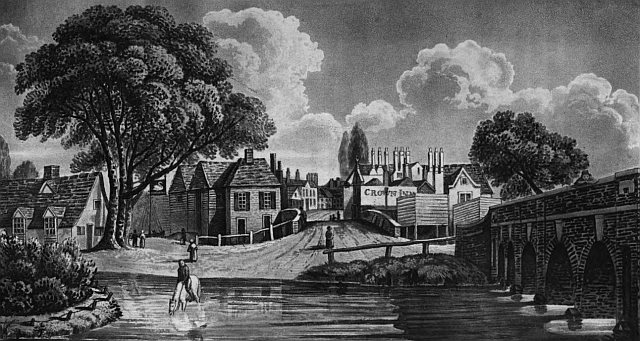
Early 1800s view of the "Crown Inn", made from the far bank of the River Colne. The building at the left of the image is the "Swan Inn"--the original Swan and Bottle (which you can visit today)

Image of the Southeast gatehouse showing the canal with a barge in the foreground. Oddly, the Treaty House in the background is inaccurately depicted.

The original image of the remodeled Treaty House. The caption that appears with it is incorrect (might have meant 1806).

This 1814 watercolor of the ruins of the Northwest gatehouse . The section of wall that appears to the right survived into the first half of the 1900's.

Another of several images published of the Southwest gatehouse and canal perspective. The figures drawn into the interior inset image are much smaller than they should be.

1937 photograph of the Treaty House showing the white stucco added during the early 1800's remodel. The little hoop on the end of the sign used to hold a crown.

Another image of the Treaty House (late1800s)

Another view of the late 1800s Treaty House looking in the direction of the River Colne

Image of the 1850 Treaty House

1857 watercolor of the Treaty House

1903 photograph of the backside of the Treaty House. At this time, the street facing sides were still stuccoed.

The same central room known (at the time of this image) as the "Oak Room"

Old photograph of the central room now called the "Treaty Room" (was not the negotiations chamber)

This 1850 image is the only historic image of the larger room at the East end of the Treaty House's second floor. The alcove at the left rear of this room is no longer there

Old photograph of the surviving carved paneling in the middle room of the second floor.

Postcard of the "5-arch" bridge over the River Colne

Cica 1831 image of the George Inn from within the courtyard behind the Inn showing the passage through onto High Street

1840 drawing of the center of Uxbridge. The Treaty House is slightly beyond this image at its upper left corner
Leave A Comment