Category: Lane’s service in the monarchy of Charles I and II

The story of Sir Richard Lane’s evolving and ultimately tragic service to Kings Charles I and II

  • Gunter’s Chains and Satellite Imagery: An Analysis of the 1775 Survey Plan at Uxbridge

    Gunter’s Chains and Satellite Imagery: An Analysis of the 1775 Survey Plan at Uxbridge

    Although I have been able to do a great deal of research from America, some portion of existing historical material simply isn’t available online. In the end, there is no substitute for time spent a fluorescent-lit archive amid a sea of box-laden shelves–or comparing notes with members of the local historical community.

    I was reminded of this truth while we were in Uxbridge recently. A member of the Uxbridge History Society shared a hand-drawn copy of a 1775 plan drawing from the Uxbridge Archives, and his own rare copy of a paper about the Treaty House by an accomplished modern historian. These two local documents provided a small trove of information that filled in a gaps in what I’ve been able to find–and one that disproved part of the model I’ve been developing of the original Treaty House structure. So, with thanks to Tony for sharing this information, I’ve been back at work on the Uxbridge Treaty House part of the Lane Project!

    Analysis of the 1775 Survey Plan

    Digging through materials related to the 1775 plan drawing at the Uxbridge Archives, I found that this document was a survey plan for the proposed straightening of the Oxford Road. This project, when completed, would irrevocably break up what remained of the original, proud property of “The Place”, two decades after the majority of the main house had been taken down.
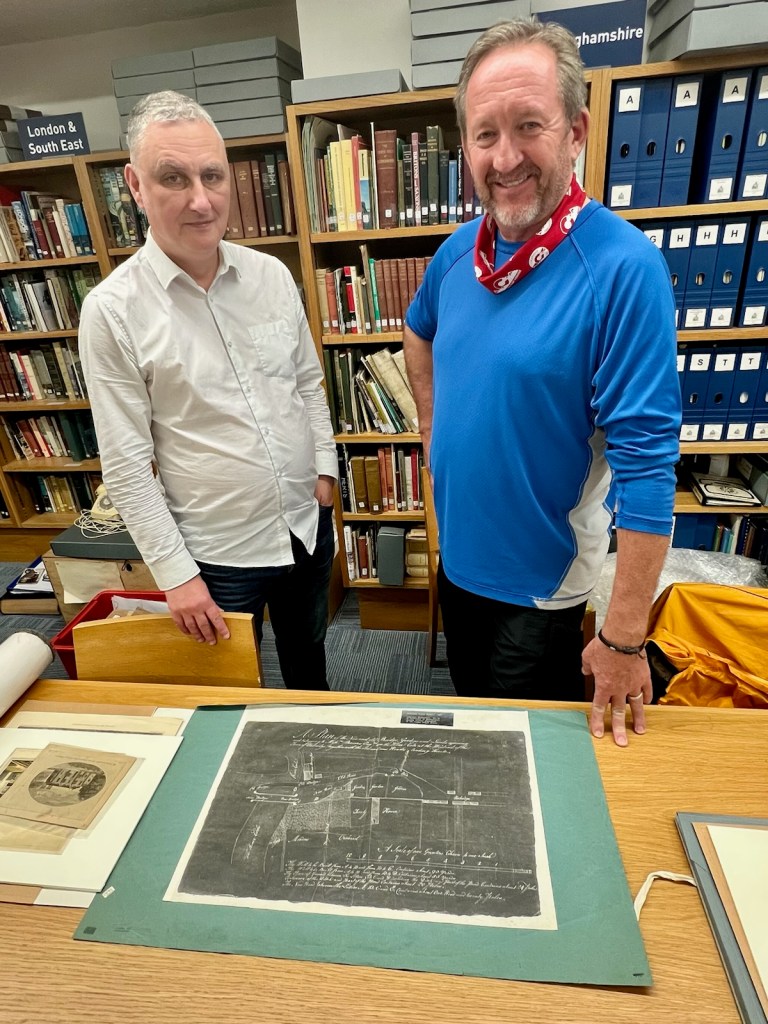
    The 1775 survey plan document in Uxbridge is actually a photostat of a negative of the original document, which is likely located at the main London Archives. This plan was produced as part of an engineering survey of the site for the planned road project.

    This is an extraordinary artifact, as it is not a sketch or artist’s impression of the scene. Rather, it is an engineering drawing that includes a surveyor’s scale, and was thus intended to be as accurate as it could reasonably have been made. The graphic below was taken directly from the document at the Uxbridge Archives. The information it contains is singular. Most diagrams I’ve been able to find of this area do not contain this level of detail, and are from after the new road was already in place.
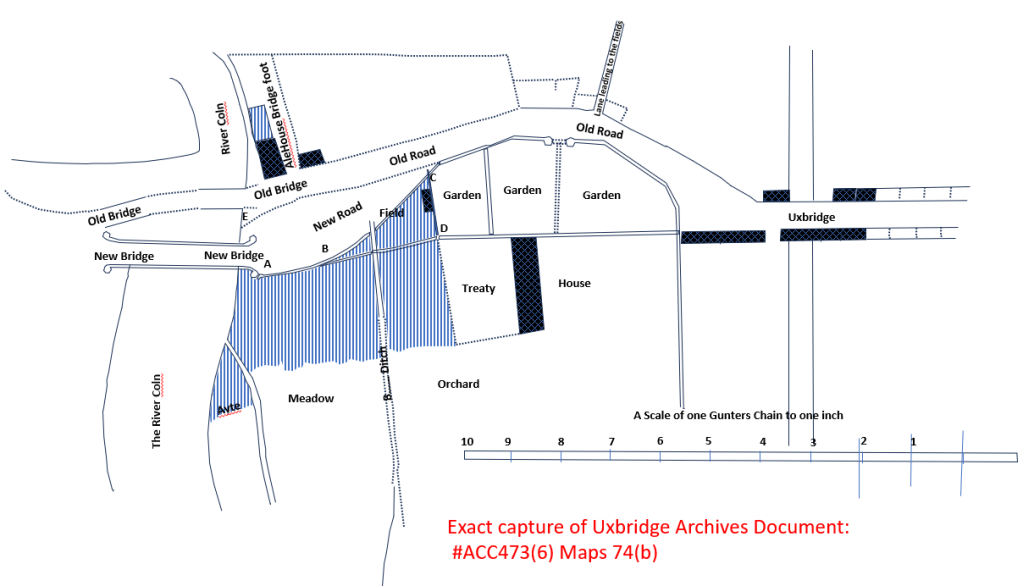
    This diagram was taken directly from a photograph of the 1775 survey plan from the Uxbridge Archives.

    There are several unique insights contained within this image. For instance, although I had read about an older “pack and prime” bridge that had been built in two segments over the Colne, I’d never seen an illustration of it. In the figure above, it is denoted as the “old” bridge. It also shows the footprints of the “Swan” alehouse and that of the remaining wing of the Treaty House (both of which still exist today).

    Despite the fact that the scene depicted is of the grounds decades after the main house had been taken down (and the property was already being sold off in parcels), many vestiges of the original grounds are still evident. For instance, the image clearly depicts the twin octagonal gatehouse (“lodges”) that flanked the original entrance to the property. Especially useful to me is the shape of the “old” Oxford Road as it arcs around the property. Before this document, I haven’t seen anything definitive about the shape of the original property. The wealth of other details (walls, fences, cultivated fields, ditches and buildings) provide a unique and satisfying view of “the neighborhood” around the Treaty House property at that time.

    There are several odd things about this image also. The Frays Stream (at right) is not a straight channel (as it is depicted), nor does it intersect the bridge and the town mill at the angle shown. Also, the gatehouses are placed at an odd geometry relative to the remaining Treaty House wing. as though the person drawing it didn’t realize that those structures were related. Prudent architectural sense would have placed the gatehouses parallel to, and centered upon, the original center span of the house. To get a better feel for what can be trusted in this image, I decided it was time to do some analysis!

    What is a Gunter’s Chain?
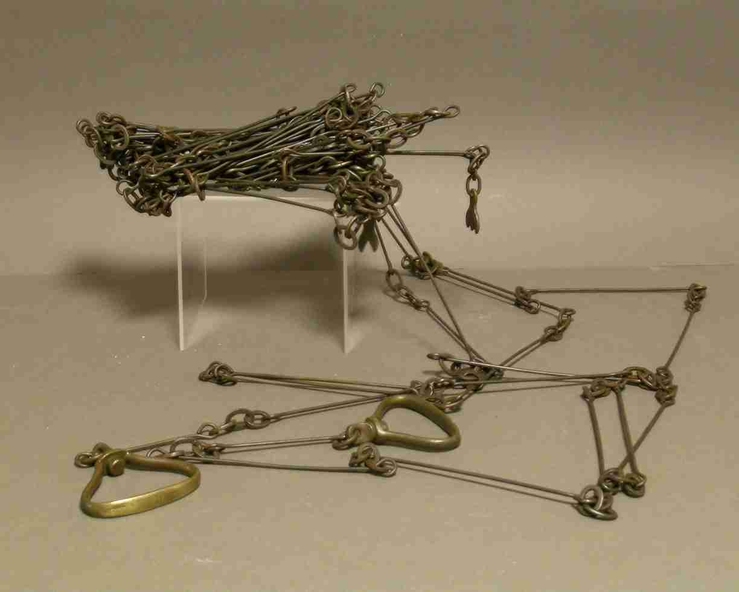
    A Gunter’s Chain. Image credit: Victorian Collection

    The text in the image refers to a “Gunter’s Chain” and provides a scale of 10 of these rulings in a line. A Gunter’s Chain was named after the English Clergyman and mathematician who introduced it in 1620, Edmund Gunter. It is a durable set of 100 links in a chain that is a total of 66 feet long, and is used exactly as we use a tape measure today–but for surveying.
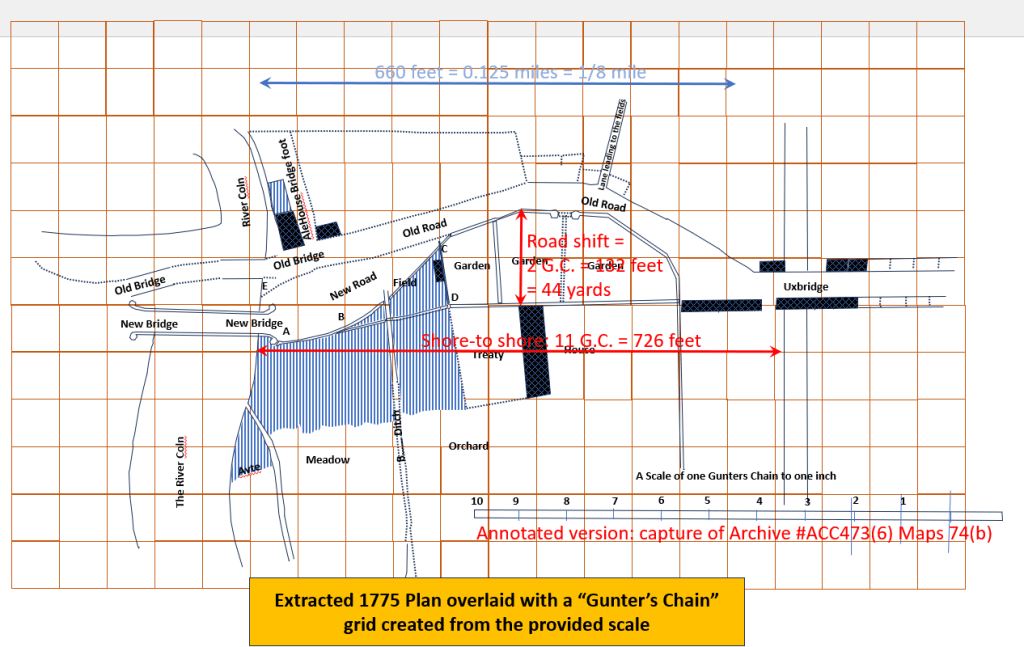
    Having a surveyor’s scale in the image was simply too much for my inner nerd to pass up! First, leveraging the provided scale, I created a 2D “Gunter’s Chain” grid, which I laid over the survey image (see image above). Since each square in this grid represents 66 square feet, this grid can be used to make measurements on the image. Overlaying the 1775 survey drawing over modern satellite imagery of the same scene and using online distance measuring tools, I can use enduring elements in the scene to assess the accuracy of the original drawing.

    First, I had to confirm that the accuracy of the online distance measurement tools themselves. If the measurement errors were larger than what I am trying to determine, then there is little point in going any further! Using the “measure distance” feature of Google Earth and repeating a specific measurement of a significant distance (approximately 1,000 feet apart in the image) achieved results with a “standard deviation” of about 1.2 feet. This is good, as this amount of error includes any intrinsic error in Google’s measurement tool and also my ability to reliably choose the exact same spots to measure each time. Next, I measured the roof peak of the Treaty house multiple times, and consistently got measurements of +/-6 inches compared with measurements of the building I made while recently in Uxbridge. Bottom line? These tools are more than accurate enough for this job!
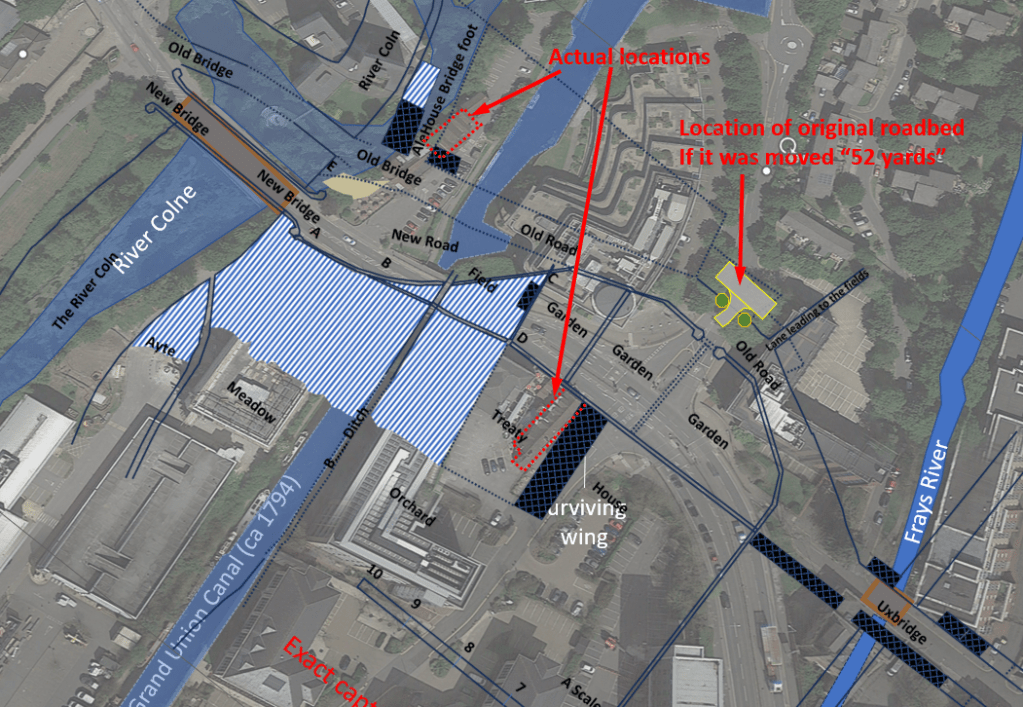
    Satellite imagery of the area around the Crown and Treaty, overlaid with the 1775 survey image. It was rotated to align the road in front of the Treaty House, and then scaled until the interior bridgeheads matched.

    I did not expect the survey map to be perfect. After all, it provides an overhead perspective drawn using only ground observations using 1600s technology. But I was pleasantly surprised how well the survey image laid onto key parts of this scene. In particular, the spatial relationship between the new roadbed and the bridgeheads at either end of it was nearly perfect. Also, the surveyed distance from one bridgehead to the other was 11 “chains” (726 feet). This matched satellite measurements (705 feet) of the same distance fairly well (given that I did not have clear visual targets for making this measurement).
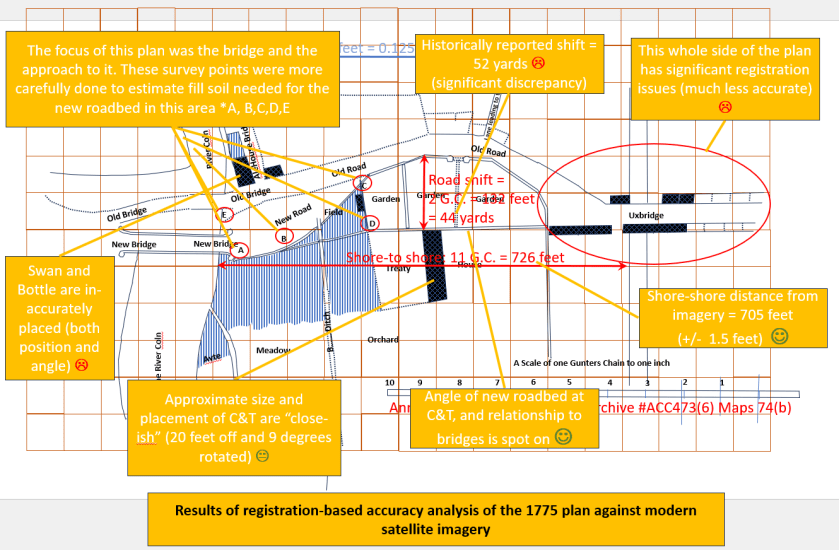
    But there were also some unexpected misalignments (see the analysis graphic above). The depicted footprints of the Treaty House and the Swan are both misplaced by at least 20 feet (in different directions), and both are somewhat rotated from their true orientations. Also, the twin gatehouses are depicted significantly closer to the new road bed than the “52 yards” the roadbed was (separately) recorded to have been moved.

    The explanation for the variation in accuracy is that certain parts of the scene were carefully surveyed, while others seem to have been drawn in for completeness. If you look closely at the plan, you will notice a grouping of 5 points called out near the Colne bridgehead (labelled A, B, C, D and E). These are specific survey points that surround the planned roadbed where it approaches the new bridgehead. In fact, the text on the plan calls out how much fill dirt would be needed to fill in this part of the road. It also makes sense that the width of the island was more accurately measured, as the length of this section of new road would have been a key metric for the project.

    But those areas which lay outside the new roadbed were not directly relevant to building the new road. These details were made for completeness of the scene, and it appears were less accurately captured by the engineer that created this plan. The next graphic of the scene summarizes which regions of this diagram I was able to validate as accurate, and others that are either suspect, or were revealed to be inaccurate.

    Dr. Richard Spence’s Article on “The Place”

    The second important artifact I obtained in Uxbridge was a paper published in the Autumn 1994 edition of The Uxbridge Record (by the Uxbridge History Society). This is an excellent paper about the early history of “The Place” (as the Treaty House property was originally known) and those who built and later owned it.
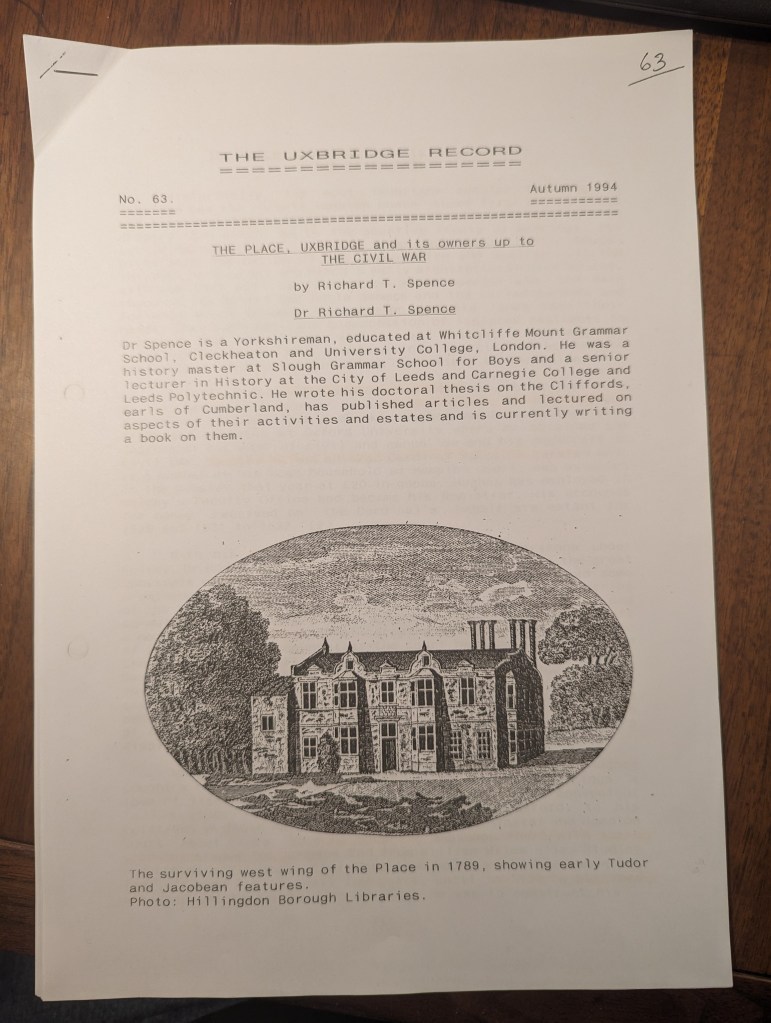
    I was surprised to learn that the author, Dr. Spence, was not a local resident–he was from Leeds, far to the north. Like myself, Dr. Spence’s attention seems to have been drawn to Uxbridge by a thread of his primary research focus. After losing his role as a Senior Lecturer at Leeds and Carnegie College during a educational consolidation at age 54, Dr. Spence retired early and threw himself into the topic of his original PhD thesis: the history of the Clifford family (Earls of Cumberland). He authored several books regarding the Cliffords and several places related to the family.

    The thread that seems to have brought Dr. Spence to the Treaty House was the granddaughter of Dr John Hughes, who originally built “The Place” in ca 1535. In her adulthood, this daughter (Grissell) married a man named Francis Clifford. The newly married couple first lived at “The Place” while Francis was constructing a bold new home amidst the rest of the Clifford family in Londonborough. Some years later, Francis succeeded his brother and became the next Earl of Cumberland. Lady Grissell (daughter of Uxbridge and raised at “The Place”) was now a countess.

    Apparently pursuing this marital link between the Cliffords and Uxbridge, Dr. Spence became interested in the Treaty House and wrote his excellent paper on it in 1994. This paper was a privilege to read. I would have loved to have met Dr. Spence, but he died in 1999–5 years after making this unique contribution to Uxbridge history. The Guardian news site has a wonderful online obituary that describes him (Richard Turfitt Spence) as a warm, gentle and witty historian and an avid club cricketer. I was able to find 6 books he published, most available on Amazon. Unfortunately, I was unable to find a photograph of him, or I would have included it. So, with a salute for excellent, singular work and the significant help it has provided me–many thanks, Dr. Spence, and rest well.

    For my work, there were several worthwhile discoveries in the Spence paper. First, while Lady Grissell and her husband Frances Clifford were living at The Place, arrangements were made to receive a visit there by Queen Elizabeth I (and her retinue) in October 1592. His description of the effort undertaken was fascinating, although Dr. Spence tells it is not clear the visit actually happened. Recall that this royal visit would have taken place only a few years after the Elizabeth I had so capably led the defense of England from the invading armada of King Phillip II of Spain in 1588. For Americans who aren’t familiar with this, watch the academy award-winning movie, Elizabeth: The Golden Age (2007)–it was Elizabeth I’s “Churchill” moment. She was at the height of her power, and her reign was an era of prosperity and relative stability compared with the chaos and religious whip-sawing of the country by King Henry VIII and his immediate successors. I suspect if this royal visit had actually taken place, it would have been an important local event that would have become part of the fabric of the property. The additional notoriety might even have saved the estate from its ultimate fate…

    A few years after Francis Clifford and Lady Grissell had moved to their new mansion at the Clifford family seat in Londonborough, the Uxbridge property was sold to Sir John Bennett in 1613. Apparently, the new Earl Francis Clifford had inherited significant debt along with his new title, and the sale of “The Place” was necessary to help resolve them.

    Sir John Bennett was already a significant landholder in the area who desired a convenient and enviable estate commensurate with his status. Sir John undertook the first great renovation and improvement of the property in 1623. As part of this costly expansion, the attic areas of both wings were built out to provide additional accommodations for his 10 children, 40 grandchildren, servants and guests.

    Dr. Spence tells that the original chimney structures contained a single flue in each turret. But as hearths were added to heat the new rooms in the attic spaces, additional flues for them were carefully fitted into the center turrets of the chimney structures. Additionally, Dr. Spence notes there may have been a revamping of an original “great hall” in the center span of the building. This update (which likely also included the fitting of the famous carved paneling) would have created the elegant spaces utilized during the treaty negotiations in 1645. With the completion of this work, the significantly upgraded property took on a new name, becoming known long after Sir John’s death as the “Bennett House”.
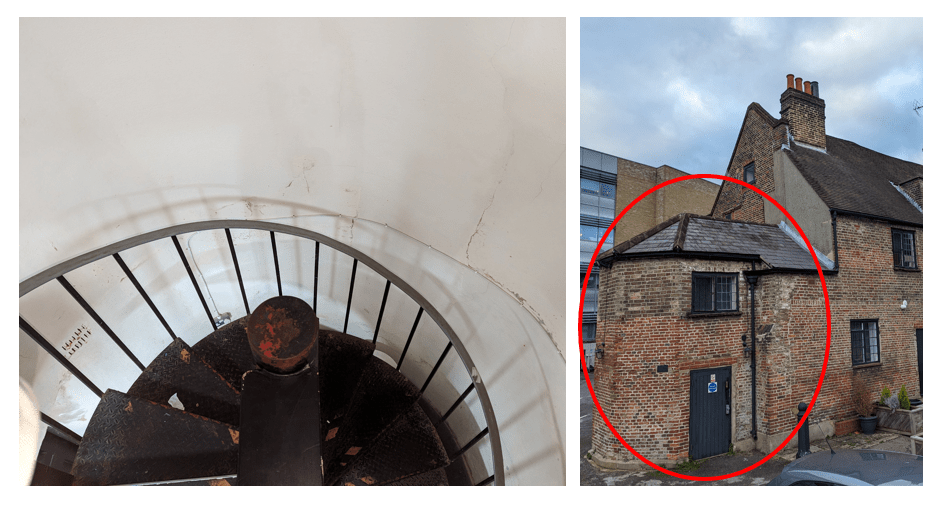
    There was one important detail in the paper I need to disagree with. Dr. Spence about. He speculates that the “good stairs” described to be at both ends of the center span’s main chamber were contained in angle turrets (as exists at the far end of the building today). However, that octagonal structure is not present in depictions of the building from the post demolition period of the latter 1700s. Although quite functional (having used them), it’s difficult to imagine anyone remarking upon them as “good stairs”. But most telling is the presence of filled-in windows in the end wall of the building which are unaligned with floors. These windows are clear evidence that an elegant stairwell was originally located within the end of the existing wing.

    Reviewing the brickwork that connects the octagonal structure to the far end of the building (and various images of the building over time), my own suspicion is that it was added sometime during the middle 1800s when the Treaty House (and the large building appended to its backside) served as an Inn.

    Finally, I was amused to read Dr. Spence’s mention of a “hearth tax” of 20 hearths on the property in 1674. This caused me to smile because the three chimney structures of the existing wing alone contain 12 flues. If the opposite wing was symmetrical, there would have been 24 flues before even considering those needed to heat the large center section of the building! My current model estimates there were an additional 2 flues at each end of the center span of the house and at least 2 full sets of chimney stacks along its back wall. This would have resulted in a total of around 34 hearths in the house at the time this tax was assessed. Apparently, tax dodging is a very old game indeed!

    Layout of the Original Treaty House
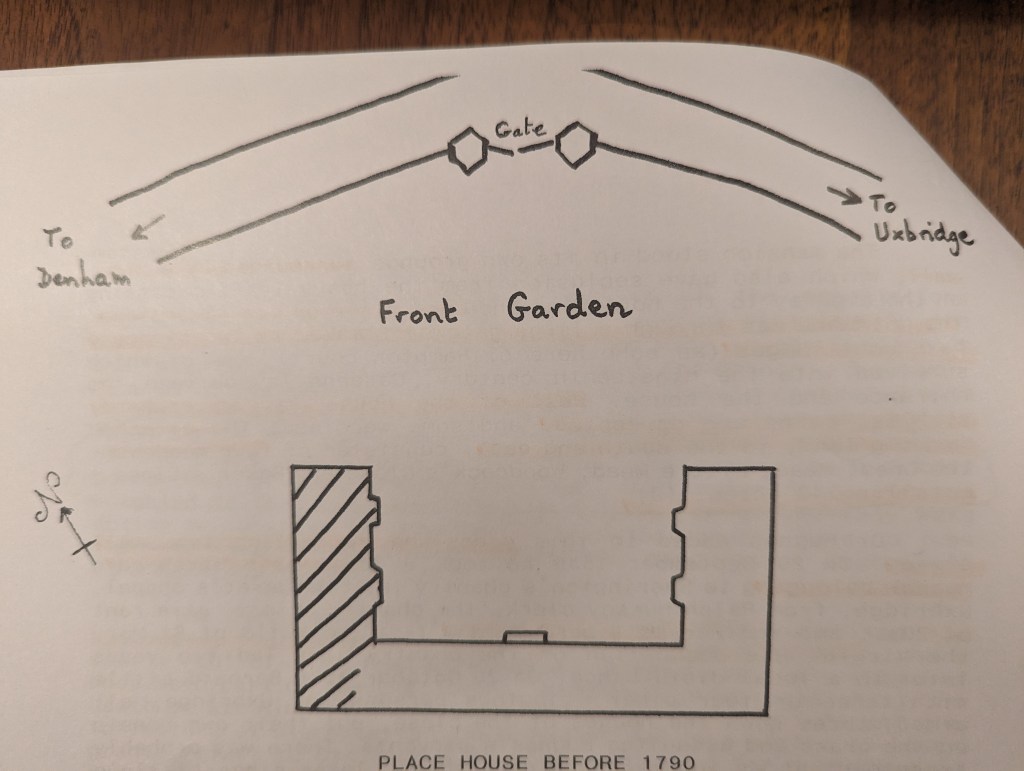
    A sketch from DR. Spence’s paper showing how he believed the original Treaty House was laid out.

    Dr Spence’s paper includes a sketch of what the original structure might have looked like. Apparently, Dr Spence shared my suspicion that the spatial relationship of the remaining wing and the gatehouses depicted in the 1775 survey plan was not fully accurate. As Dr. Spence has illustrated, it is far more likely the twin gatehouses would have been centered on the house and arranged parallel to the face of the center span.

    In my next article, I will share the the resolution of some nagging incongruities with the simple layout depicted above. There is more to know about how the wings actually attached to the center span. The clues lie in the tortured walls at the far end of the remaining structure…

    For the last few years, Mary and I have been discussing the possibility of an extended visit to the UK that would allow me to do some much needed in-person research for this project. With the wind-down of the pandemic and the passing of a much loved, furry member of our family last year, we have decided it’s time.

    We are both excited and nervous, of course. Its already hard to think about being away from our friends and family for an extended period, but this is something we don’t want to look back on later and regret not doing when we could still do it well. Having made new friends in Uxbridge, we are very grateful we will have a community to make our own for awhile. It will be wonderful to do simple things like making meals together!
    Of course, we plan on making the most of the opportunity for adventure, and are bringing our road bikes and hiking poles. We are looking forward to exploring a great deal of England, Scotland and Ireland (and our most yearned-for places in Europe) in our down time!

    For now, we still have quite a few arrangements to make, including finding a fill-in drummer for my band. Regarding my research, I am filling out my list of topics I haven’t been able to run to ground from America. I will also have to decide which books I will really need to have with me. But by this fall, I hope to be putting in some quality time in the archives of London, Oxford, Northampton and Somerset. And making time to meet with some acquaintances we’d enjoy seeing again–especially without having to rush the visit this time!

  • My Uxbridge Opus: Resurrecting a Fabulous Historic Site Unseen for Nearly 300 Years

    My Uxbridge Opus: Resurrecting a Fabulous Historic Site Unseen for Nearly 300 Years

    Note: The second model of the original building postulated in the second half of this (earlier) article has an important flaw. The subsequent articles listed here tell the story of how the mystery of the original architecture was (finally) resolved, resulting in the third (3D) model.

    -Greg


    It was a jarring realization that the Uxbridge Treaty House is only a single surviving wing of a much grander original structure. This takes nothing away from the lovely existing building–it is a treasure, and feels complete on its own. But perhaps because it feels complete and seems to have always been perceived in variations of its current form, there remains little room to comprehend the true scale of the “fine house” and grounds that hosted the Peace Treaty Negotiations there in 1645. We can be forgiven having difficulty imagining it since (as we learned in my last article), among the mountain of images of his historic structure, not one of the original structure seems to have survived.

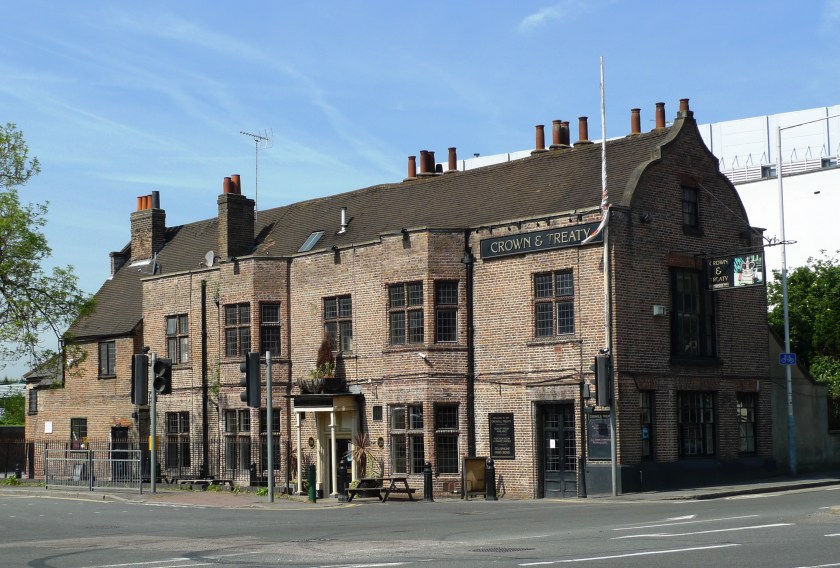
    Crown and Treaty, Uxbridge. Photo credit Wikipedia.

    To better understand the historic event that took place there over nearly a month, I shifted my focus to sweeping together all the bits of clues I’d found and creating the best model I could of the original house.  To my surprise, I have been able to integrate these many shards into a remarkably cohesive and durable model, including a fair portion of its interior arrangements.

    You see, in its time, the original Treaty House and grounds were far more grand (and dominant) than what remains today would suggest. My research has led me to believe that to say that “the negotiations took place in a part of the house that has since been taken down” is much akin to presenting a single tire as a bicycle with some parts missing!

    The Mystery of the Original Treaty House

    Perhaps the most useful aspect of my Uxbridge research has been reinforcement of the need to remain wary of falling in love with a particular theory. There are nearly always breadcrumbs of information to be discovered, but what should we make of them?  However, even chasing a theory that ultimately proves incorrect can be very useful. Nearly every time I have found myself officiating the frustrated funeral of an beloved theory, I’ve found the effort to validate it has led me to compelling insights I wouldn’t have come to any other way.

    Although I do as much of my research online as possible, quite often I need to either borrow or buy books pointed to by footnotes to find the details I am looking for. My physical library has grown a whole new section of books related to my research into Uxbridge and the Treaty House.

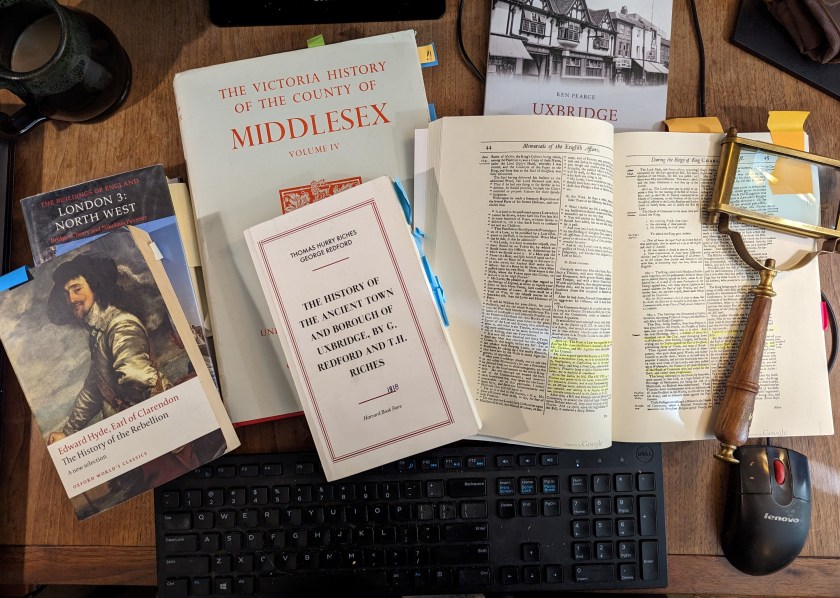
    My search for clues regarding the form of the original Treaty House led me to a few important sources. The first is a remarkable 1818 book of Uxbridge history called “The History of the Ancient Town and Borough of Uxbridge” by G. Redford and T.H. Riches.  This wonderful work contains the most significant (and well substantiated) record of the history of the house I have found. Captured by period historians in the early 1800’s, this book also includes many  fascinating notes about the state of the town at that time.  Reading this book two hundred years later, these glimpses into the early 1800’s Uxbridge inhabited by its authors were as interesting as the excellent historical research that was the focus of their work!

    From the Riches/Redford book I have gathered the following important points:

    • The original house was likely built sometime in the latter 1500’s (1576?). For much of its early history, this house was the seat of the Bennett family.
    • The original house “which was then considerably larger than at present [i.e. 1818], stood in the centre of a large garden. The high road now [in 1818], passes through nearly the middle of the grounds.” Note: other sources I have found indicate the surviving building was roughly 1/3 of the original structure.
    • The property was apparently partitioned in 1724.
    • Following the death of the last Bennett (Leonora, Lady Bennett) in 1638, the property went through a handful of owners over the next century. At the time of the treaty negotiations in 1645, it was the property of a “Mr. Carr”.

    The second source of critical information I added to my collection is one volume of a carefully written set analyzing the architectural history of the buildings of England. This particular volume is titled “The Buildings of England, London 3: North West” (1991). Amidst a sea of elaborately developed details about innumerable other important historic buildings, this remarkable book distills a history and architectural analysis of the Crown & Treaty into a single, un-illustrated paragraph at the bottom of page 363. I found this tiny account while following up on an obscure footnote from a different, modern architectural publication.

    This is the architectural history book that yielded the critical, singular clue about the layout of the original Treaty House.

    I laugh to myself at having had to purchase a book that is more than an inch thick (containing 804 pages) to access a single blurb of information that would almost fit on a business card.  But that concise little blurb was absolutely worth the trouble and expense! Among a number of other useful details, it contained a singular critical clue I needed about the layout of the original Treaty House.

    And so, in a passage that could likely be read aloud in a few breaths, I found the following gems:

    • The Crown and Treaty was converted to an inn in 1802 after the property was purchased by the canal company to build a wharf for the Grand Canal. Note: the Grand Canal itself (which passes behind the Treaty House) was completed in 1793-4.
    • About the building’s history, the book states, “The present building consists of one wing of the formerly half-H shaped Treaty House…”
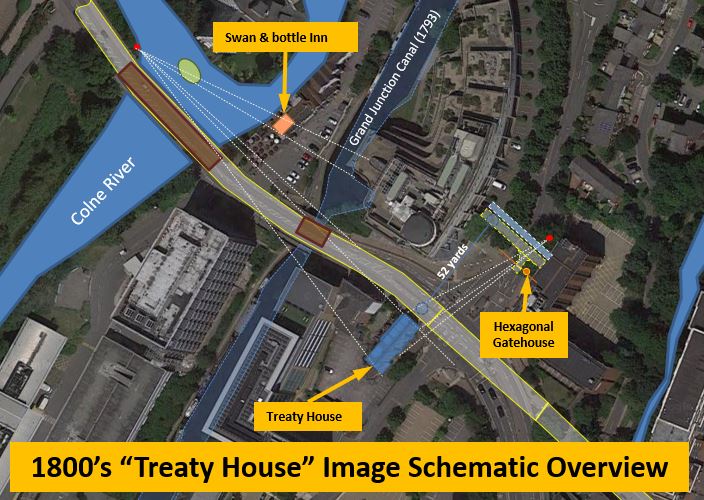
    • The rest of the building “was demolished in the 1750’s, and the road was later diverted across the forecourt.” From another source I learned the roadbed had been moved 52 yards from its original path.
    Overhead schematic view of the relocated Oxford Road and the existing Treaty House, showing the probable locations of artist renderings from the Colne River and the hexagonal gatehouse.

    The third great resource I found was a book  by John Rushworth which provides the following first hand account:

    “This place being within the Parliament’s Quarters their Commissioners were the more civil and desirous to afford Accommodations to the King’s Commissioners, and they thought it fit to appoint Sir John Bennet’s House at the further end of the Town, to be fitted for the place of meeting for the Treaty.

    The Fore-way into the House was appointed for the King’s Commissioners to come in at, and the Back-way for the Parliament’s Commissioners; in the middle of the House, was a fair great Chamber where they caused a large Table to be made like that heretofore in the Star-Chamber, almost square and without any upper or lower end of it. [note: another source indicates the negotiations room was on the upper floor].

    The King’s Commissioners had one end and one side of the Table for them, the other side was for the Parliament’s Commissioners, and the end appointed for the Scots Commissioners to fit by themselves. Behind the Chair of the Commissioners on both sides sate the Divines and Secretaries, and such of the Commissioners as had not room to fit next to the Table.

    At each end of the great Chamber was a fair Withdrawing-Room and Inner-Chamber, one for the King’s, and the other for the Parliament’s Commissioners to retire unto, and consult when they pleased.”

    John Rushworth, ‘Historical Collections: The Treaty at Uxbridge, 1645

    A Quick Aside: The Table at the “Star Chamber

    Rushworth’s observations about the negotiation table was a particularly valuable clue. A large square table had been custom made for the treaty negotiations. And, this table was “like that heretofore in the Star-Chamber”. But what does that mean? I think many of us have heard of the Star Chamber.

    Aside from being a contender for the most intriguing name ever, the Star Chamber was both an actual room at Westminster Palace and also a colloquialism for the medieval “Court of Star Chamber” that gathered there. This infamous court is a tale of well-intentioned ideas gone horribly wrong. Conceived as as something like a Supreme Court, the Star Chamber served as a court of appeals from lower courts. It also had a second, very important purpose. Composed of a combination of privy councillors and senior judges of the common law, the Star Chamber was also charged with the task of hearing cases against those so powerful they were unlikely to ever be convicted by lower courts. The Star Chamber was an important step in the transition from the medieval to modern institutions of governance.

    Lauded in its first few decades for its efficiency, flexibility and fairness, this special court was weaponized in the reign of Henry VIII as a tool of political oppression. Unfortunately, once begun, the abuse of this court’s power continued for more than a hundred years–well into the reign of King Charles I. The Court of Star Chamber was finally abolished by the rising parliament led by John Pym in 1641–one year before the start of the English Civil War.

    John Pym was a busy man in 1641. Perhaps you remember him from my recent articles analyzing the “Trial of Strafford” painting that hangs in the House of Lords at Westminster? In that painting, Pym is depicted illuminated in mid-oration as he himself (successfully) weaponizes the House of Commons as an instrument of the assassination of a key supporter of King Charles I: the Earl of Strafford, Thomas Wentworth. Although Pym was the architect of the Parliament’s effort to wrest power of the government from the crown in the English Civil War, he was not among the parliamentary commissioners present at Uxbridge in 1645. He had died of illness a year before.

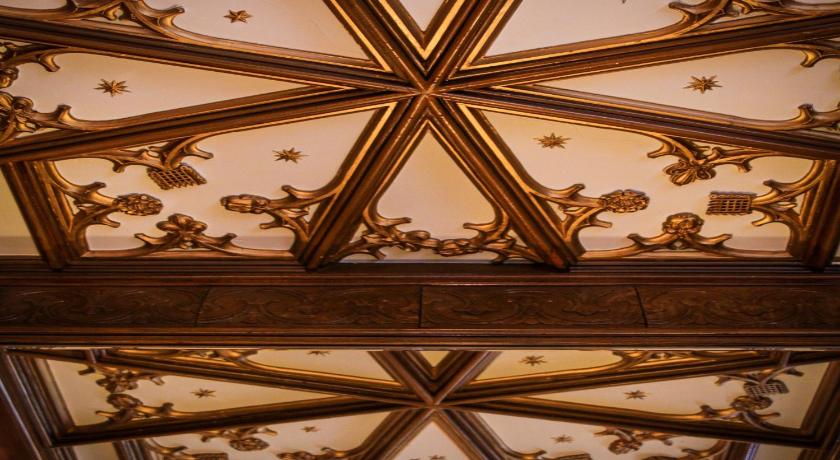
    This image shows the famous Star Chamber ceiling now preserved (with a cream background instead of blue) at Leasowe Castle. Photo Credit: Leasowe Castle Hotel.

    Ironically, the Rushford clue about the large square negotiating table at Uxbridge may be the only real clue about the original furnishing of the Star Chamber itself (except for the dark blue ceiling with ornate gold stars the chamber is named for). When the chamber was demolished in the early 1800’s the ceiling and tapestries were salvaged and taken to the Leasowe Castle on the coast of the Irish Sea near Liverpool. You can see this ceiling today if you stay at the Leasowe Castle Hotel!

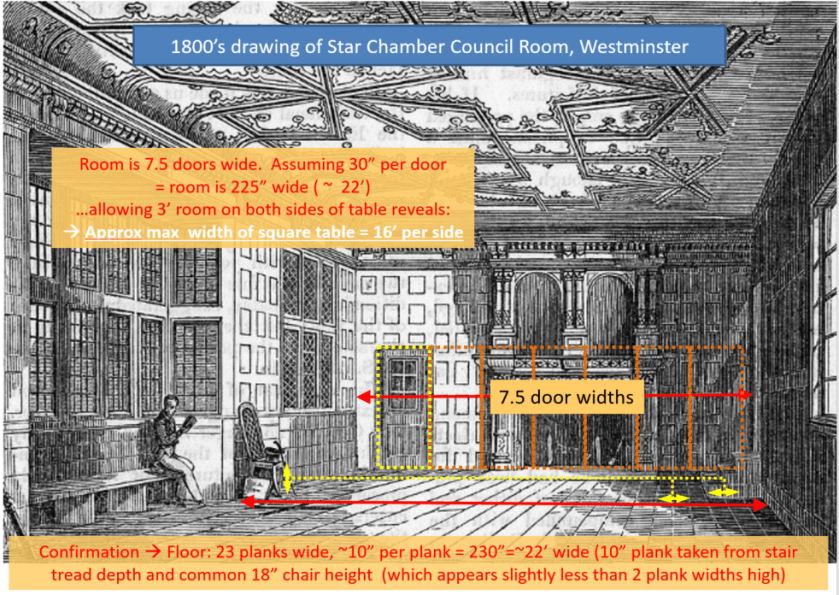
    Looking at the drawing of the Star Chamber below, it seems that the room was rectangular, with the lesser dimension along the far wall. In this graphic, you can see the spatial analysis I used to estimate this room to be approximately 22 feet in width. Considering how large a table could occupy this space usably, I would estimate the table width could be as much as 16 feet on a side. Assuming humans have not dramatically changed their dimensions and allowing 2 feet per seated person, such a table would have seated as many as 8 people along each of its sides.

    This is my spatial analysis of an image of the Star Chamber at Westminster and the table it once contained.

    In Uxbridge, this would mean that roughly half of each side’s 32 commissioners (16 people) could have sat at the table, and at least this same number of seats behind the railings would have been required for the other half of the commissioners (and any other important attendees–the “Devines and Secretaries”). This is an important bit of information, as the size of this table and some idea of the minimum seating around it provides a defining bound on the minimum immediate space required to accommodate these negotiations.

    First Model of the Original Layout of the Treaty House

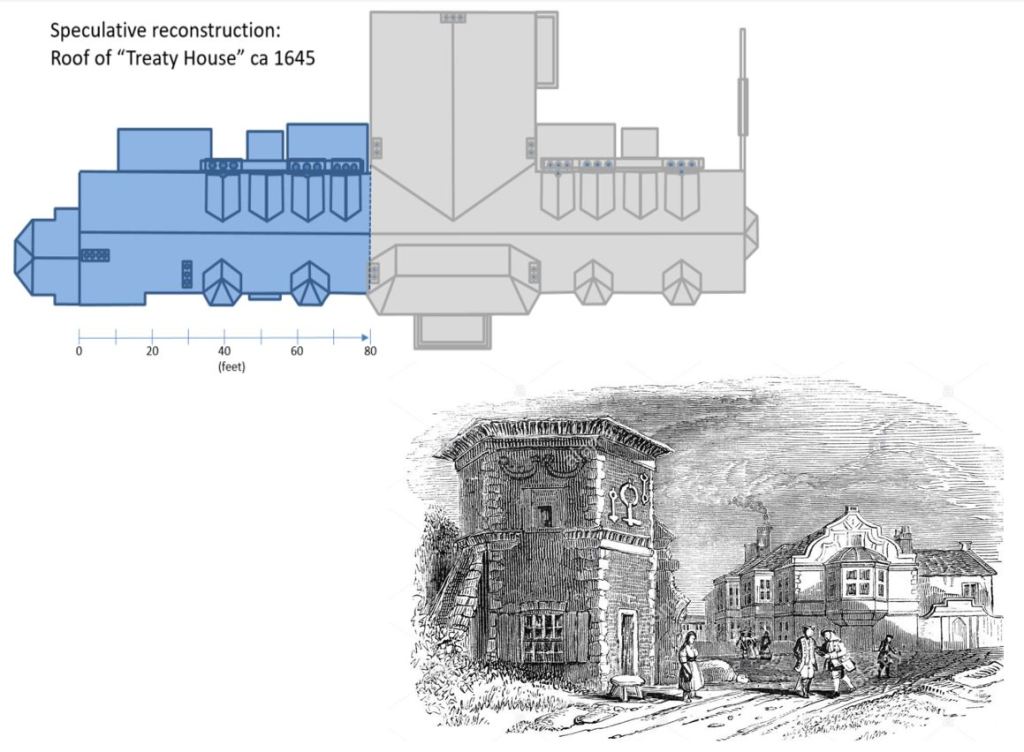
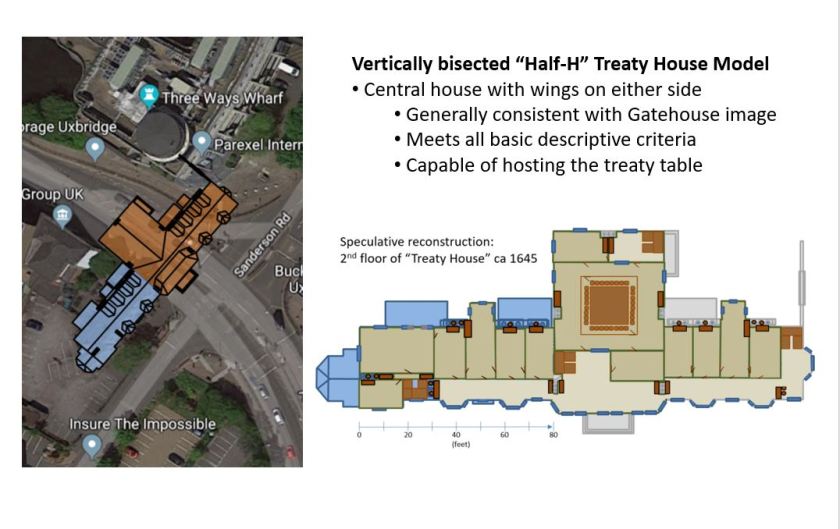
     For awhile, I was convinced the “gatehouse” image discussed in my prior article could have been of the original Treaty House.  Given that the original house was described as a “half H”, the question is: how do you split that “H”? Assuming it was split vertically, the wings would have been aligned along the same axis on either side of a center structure of the house (see the graphics of my first overhead model, below).

    First model of the original Treaty House. In this model, the two wings would have oriented along the same axis along opposite sides of a central structure.

    Under this assumption, the view from the gatehouse image would have been looking at the far end of the “other” wing, and the surviving wing of the structure would have been almost entirely hidden from view. In my second graphic, this overhead model is laid onto satellite imagery. From this overlaid image, it is apparent that this model certainly meets the criteria that the relocated Oxford Road passes “through the center” of the original house!

    The second graphic reflects my modeling of the second floor of this version of the original building. The second wing is a mirror image of the existing wing. In the center section of the building, I continued the Elizabethan “gallery” along the front windows. I added fireplaces in reasonable locations to provide the ability to heat those spaces during cold weather. Given the size of what might have been originally conceived as a ballroom space, I added fireplaces in opposing walls for heating. Then, I identified reasonable stairwell locations and antechambers while leaving withdrawing spaces through which attendees could access the main chamber without interrupting discussions in the private chambers.

    When doing such modeling, it is important to keep in mind that the model must make sense for the purposes such a building might have been originally designed to accommodate. Certainly, given its location in an inn-stop town along such an important road would have made it a good candidate for hosting official functions (such as circuit court proceedings, government meetings, etc). Also, hosting large entertainment events (such as balls or masques) would have had political benefits to the building’s owner. But perhaps more interesting to its architect would have been the prospect of creating a Middlesex venue that could host royal visits or other important events of state. Such an ambition would have been a natural motivation for the investments in the park-like grounds and attractive architecture of the building. The design of the gatehouse is far from merely functional–it was meant to impress! And if that had been part of architectural vision for this property, those investments had certainly paid off in 1645.

    So how did this interior model feel? How well did it meet the criteria defined by the evidence I’d gathered? I gave it a solid maybe. It met the criteria, but the center building seemed a bit wide, raising concerns about how it could be supported structurally. The “withdrawing ” areas feel more cramped than implied, and narrowing the building would have made them even smaller. The original interior arrangement might have been like this, but it feels a bit forced.

    Eventually, I determined there were two inescapable problems with this model. First, although the depiction details seem a bit “muddy” in the original version of the image I was working with, the left-facing protrusions in the image don’t quite align with the model. If the center of the house did not protrude beyond the primary wall of the wings, you would have seen all four bay windows of the wings in that line of sight.  If it did protrude, the center section would have eclipsed the view of the two more distant bay columns, leaving three apparent protrusions from this viewpoint. The image only depicts two. In the end, I had to give the artist credit.  This is an excellent depiction, and the artist that did it would not have gotten that detail wrong.

    The second realization was a more definite discrepancy. In this arrangement, the face of the building nearest the artist in the gatehouse image would have been approximately 120 feet closer to the artist than the current, Oxford Road face is today (accounting for the width of the center section of the building and the length of the nearer wing combined). So, if the roadbed was moved 52 yards (or 156 feet) from its original location to its current location next to face of the surviving wing, the visible face of the original eastern wing would only have been about 40 feet from the original roadbed–which lay outside the wall. Of course, the nearest face of the building in the depiction is much further away than this.

    My Second Model of the Original Treaty House

    After I got a good sulk out of my system, my curiosity rose again, and I retrieved my frustration-flung papers from the floor. The vertically bisected layout was a non-starter. So what did that leave? It was time to reconsider the other way to interpret “half H” as the description of a shape.  If the “H” were instead bisected horizontally, it produces a horseshoe-like shape.  I had thought of this earlier, but had dismissed it as a non-intuitive way to describe this shape. But there really was no other remaining way to form a “half H”.

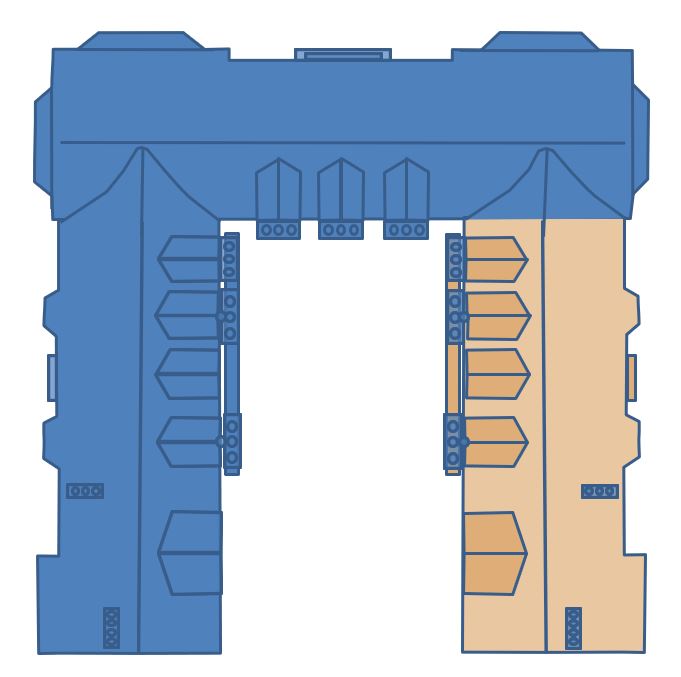
    So I began work on my second reconstruction model, this time with two parallel wings joined by a center span at one end–forming a horizontally-bisected “half H”.

    Overhead layout of my second model of the original Treaty House.

    In this model, the two wings lie parallel to one another, and are mirror images of one another. Because the house was at the “center of a large garden”, the windows would have looked outward onto gardens from either wing. In this arrangement, the chimney sides of the two wings would have faced each other. Similarly, the center span would have also featured chimneys along its back wall and featured significant windows looking out over the portion of the gardens directly in front of the house.

    Note that the center span could not have been at the other end of the wings. This would have formed the classic “E” arrangement where the front door lies within the arms of the wings. Also, in such an arrangement, the relocated Oxford Road would not have passed through the center of the original building.

    The semi-enclosed space between the wings would have been interesting. The artful chimneys would have made it quite striking from the few windows available. But given the logistical realities of the time, I suspect this would have been a largely utilitarian space. At a minimum, it likely would have included wagon delivery parking and service doors for access to the kitchen and storage areas, a protected well for water and and protected storage for firewood.

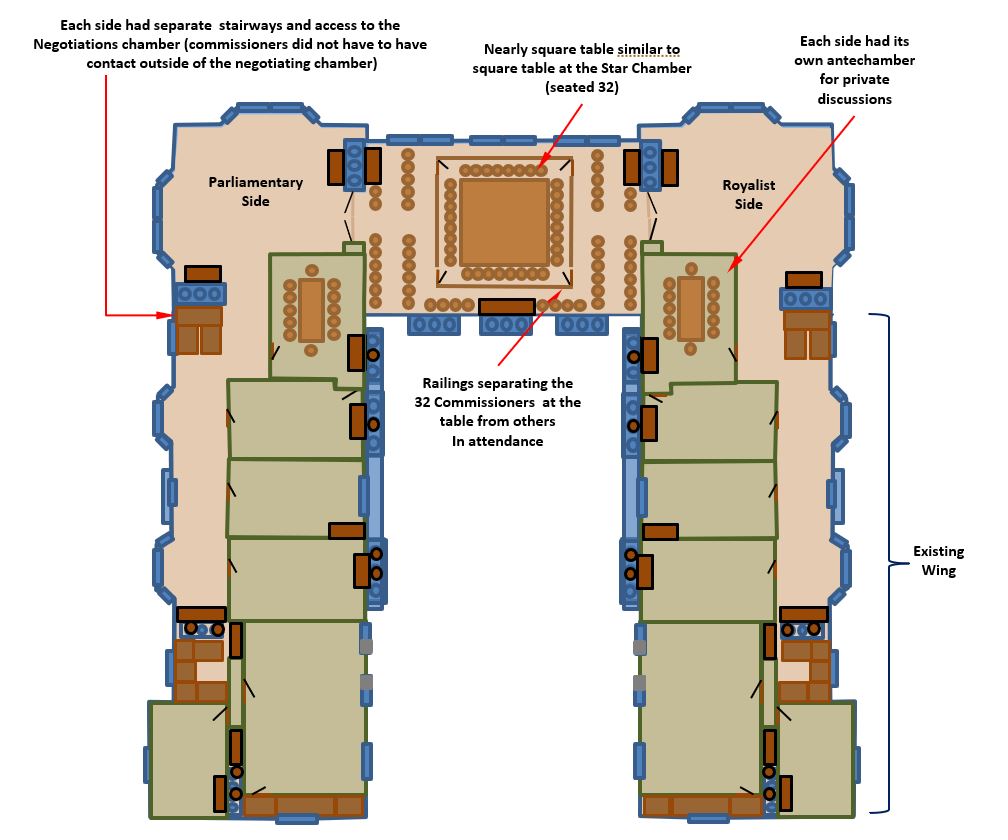
    In the next graphic, you can see my interior model of the building. As indicated in the notes I’ve gathered, the negotiations chamber was in the center section of the building on the upper (second) floor, as illustrated.

    The interior portion of my second reconstruction model of the original Treaty House.

    In this model, the Royalist commissioners would have entered through the center door on the right (surviving) wing. Since it was closer to town this would have reasonably been described as the “Fore-way”. The parliamentary commissioners would have walked around the building and entered via the side door on the opposite wing (the “back-way”). Each would have turned toward the center of the building and ascended stairs to the second floor, where they could choose to enter their antechamber(s) or the large windowed “withdrawing room” for their side.

    When ready to join the negotiations, the commissioners would pass through ornate double doors to enter the central “ballroom”. Arrangements of elegant chairs lined either side of a path to the central railing. Entering through gates in the railing, the commissioners made their way to their seats at the expansive table. Much as the mythical “round table” imagined by Chaucer for King Arthur and his knights, this brilliantly conceived table had no “head” and so placed all the commissioners on respectfully equal footing during these talks.

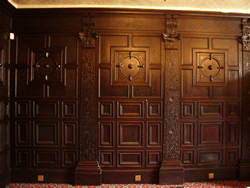
    The ornate original panelling adorning the existing Treaty House today.

    The surrounding walls of these spaces were likely fitted with the same famous rich panelling preserved in the surviving wing of the Treaty House. The walls were hung with many rich (likely official, state themed) tapestries to mark the occasion. Many-candled chandeliers above the table and sconces around the chamber provided most of the evening lighting, as the negotiations often did not end until after midnight. The rich, heavy drapes around the large windows were likely pulled closed as night fell, or as needed to trade away light for warmth during the bitter cold. When the drapes were open, the attendees could look out over the expansive gardens that lay between the house and high ornate wall standing more than 100 feet away. Within the chamber, the crackling of multiple fires provided islands of warmth to those gathered nearby.

    Of course, there is some room for variance from this interior model, but perhaps not as much as you might think. With a gardens all around, and many windows facing them, the area nearest those windows would have generally been open in the Elizabethan gallery style. The pattern of fireplace placement with each room or space having at least one fireplace, plus orthogonally facing fireplaces at the boundaries of the large glassed in spaces) was taken from the existing structure and common practices with such galleries. The main “ballroom” would have been as large as possible, so this space would have been open completely between the outside walls (on the order of 30 feet wide).

    Large closable doorways were probably situated between the central chamber and the large “withdrawing” areas on each side. This would have allowed flexibility in how the space was used. When open, these large doors would make the conjoined space space feel fairly continuous. When closed, such doors would allow the spaces to be isolated so they could be used separately and could be more effectively heated. Also, the wall structure such doors would have been built into was likely architecturally necessary to house fireplaces near the windows and load bearing columns to support the roof over such significant spans. Such columns needed to be placed somewhere, and the space in the middle of of the central room must have been unobstructed. Otherwise, it could not have accommodated the large table.

    In my opinion, the most vulnerable details of this interior model are the placement of the stairs and the walls of the antechambers. For example, the staircases might reasonably have been located in the “withdrawing” areas and could have been implemented in any of several layouts. No matter where they were placed, these staircases would have been elegant. The more practical staff stairwells would have been located at the far end of the wings.

    This overview of the grounds of the original Treaty House provides an estimate of the extent of its grounds. The famous gatehouse is included, but there certainly would have been additional gates.

    The next graphic is my model of the estate itself. Although the boundaries of the property could easily have been any among a variety of irregular polygons, the building’s location mid-way between the beds of the Colne and Frays rivers and the hint of equidistance in the description of the house (lying “at the center” of a large gardens) led me to assume a roughly square boundary for the estate wall with its sides aligned to the walls of the existing structure. Of course, the size of this square was yielded by the fact that this estate was bisected by the road, which had been moved “52 yards” to align it with the bridges crossing the Colne and the Grand Junction Canal and then Mercer’s bridge across the Frays stream. Geometrically, this would have made the walled-in grounds approximately 300-350 feet on each side.

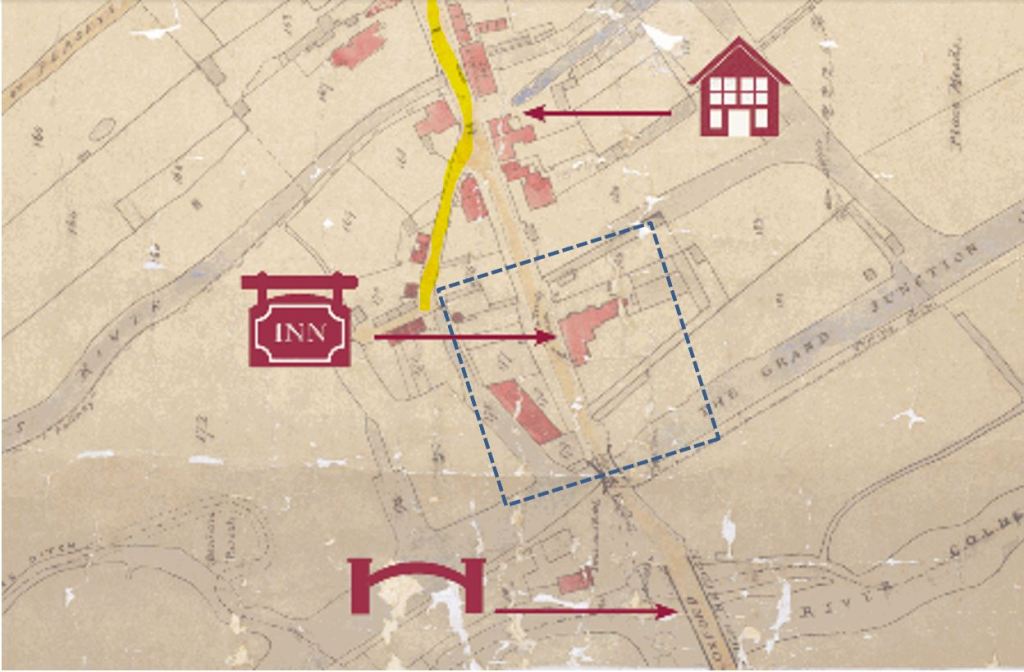
    Recently, I got a gratifying confirmation of this speculation. I came across a pair of 1825 maps of Uxbridge showing road details and also the township boundaries. The first is a map (below) of the roadways and primary buildings present in Uxbridge at that time (1825). I have overlaid a properly scaled square of my estimated estate walls and registered it against the red outline of the Treaty House footprint at that time. In this map, there is a spur in the roadway from High Street just after it crosses the Frays stream. from High Street. This spur (which I believe was a vestige of the original bed of the Oxford Road, traces a path directly around the corner of my estimated estate wall!

    Annotated detail view of an 1825 Map of Uxbridge in the collection of the Hillingdon Council. This view shows what appears to be a vestige of the original road around the Treaty House grounds, and even seems to show the location of the hexagonal gatehouse. Note: North is to the left.

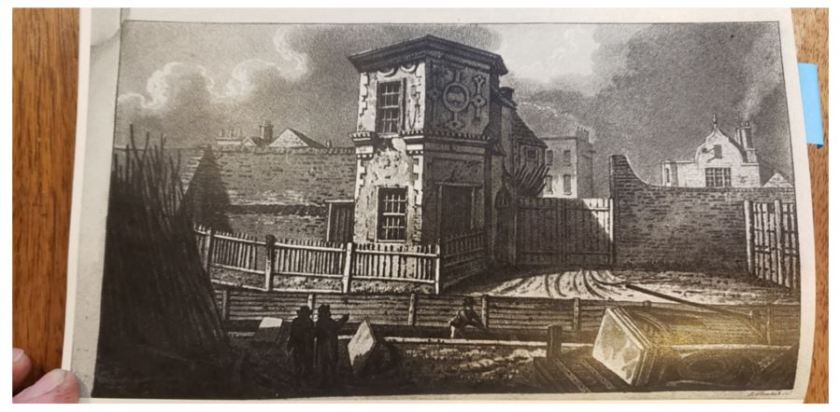
    Even more interesting–look closely at that corner of the property. Do you see that small red dot just inside the dotted line? I suspect this was the footprint of the hexagonal gatehouse, apparently still in existence at this time. Lying next to that gatehouse you can also see the end of a light blue canal leading back to the Grand Canal. If this scene seems familiar, it should. This is exactly the scene in the middle 1800’s gatehouse drawings which depict a canal passing directly in front of the elegantly dilapidated hexagonal gatehouse, with the surviving Treaty House building in the background.

    One of several middle 1800s depictions of the hexagonal gatehouse in the foreground. Note the reinforced walls of the canal and the canal boat depicted passing by.

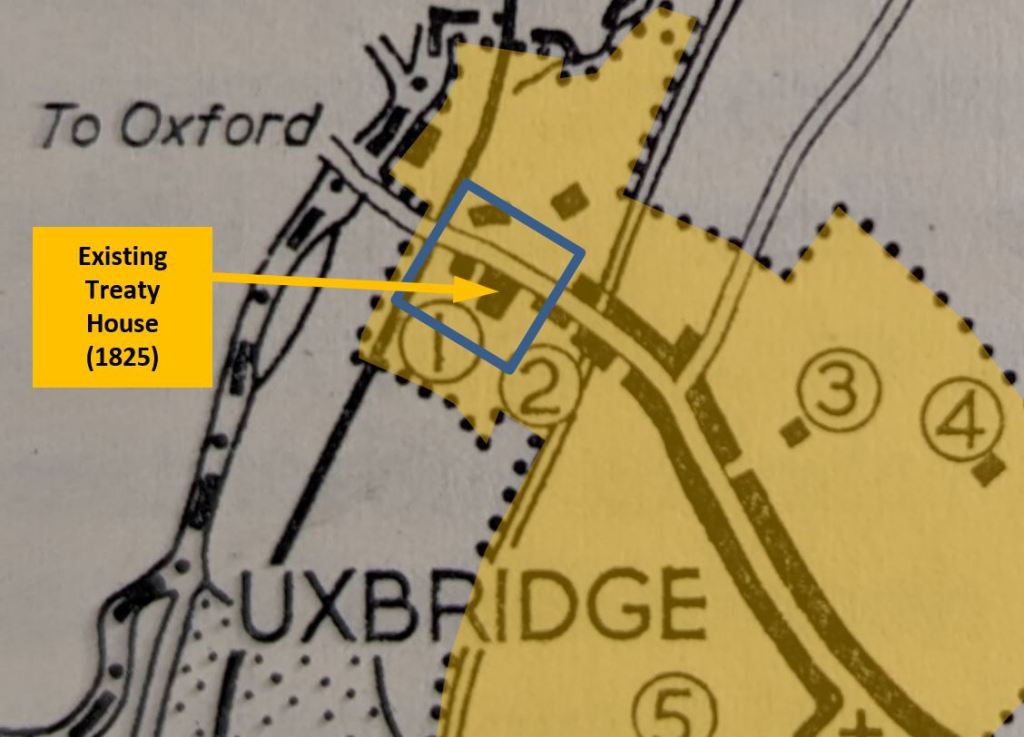
    The next graphic is taken from a different 1825 map that illustrated the boundary of the Uxbridge township at that time. I had actually expected the property the Treaty House was built on to be much more elongated, extending to the South. I was a bit shocked to find the township boundary directly parallels the rear wall of the estate in my model of the grounds! This apparent extension of the township boundary (which otherwise lies to the east of the Frays stream) provides an interesting indicator of the footprint of the developed properties at that time.

    Detail from an 1825 map of Hillingdon Parish that shows boundary of the Uxbridge township (which I have highlighted in yellow). Note this township boundary includes a rectangular shape that encompasses my estimated estate grounds of the original Treaty House.

    To anyone who has ever owned and cared for horses for any period of time, leaving an apron of land beyond the walled-in part of the grounds wall makes perfect sense. Every time you “muck the stalls”, the cartload of horse manure and straw collected has to be dumped somewhere, and you would not want that inside the estate walls! Naturally, these estate walls would have included several utility gateways. Perhaps none was more utilized the one that would have been located near the outbuildings (and stables) at the rear of the walled-in estate. This “back-wall” gate would likely gotten significant use as manure carts, horses being grazed and wagons carrying firewood harvested from the commons passed through it.

    That was a lot to cover, so if you made it this far, thanks for your interest in this work. Now, with the main course out of the way, it’s time for the dessert! In my next article, I will be presenting the wonderful, long sought image of the original Treaty House created by the talented artist helping me with this reconstruction.


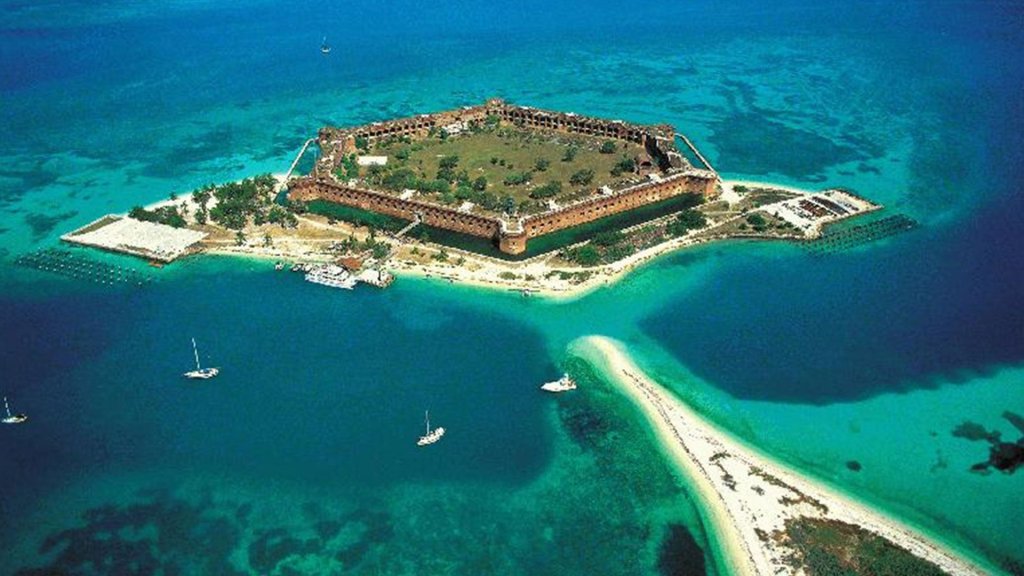
    It’s great to be writing again, and it will be wonderful to turn my attention back the queue of other articles that has been on hold for so long. I’m adding this section to my articles to share some of the other interesting things competing for my time. Most recently, this was our “bucket list” adventure at “Dry Tortugas”.

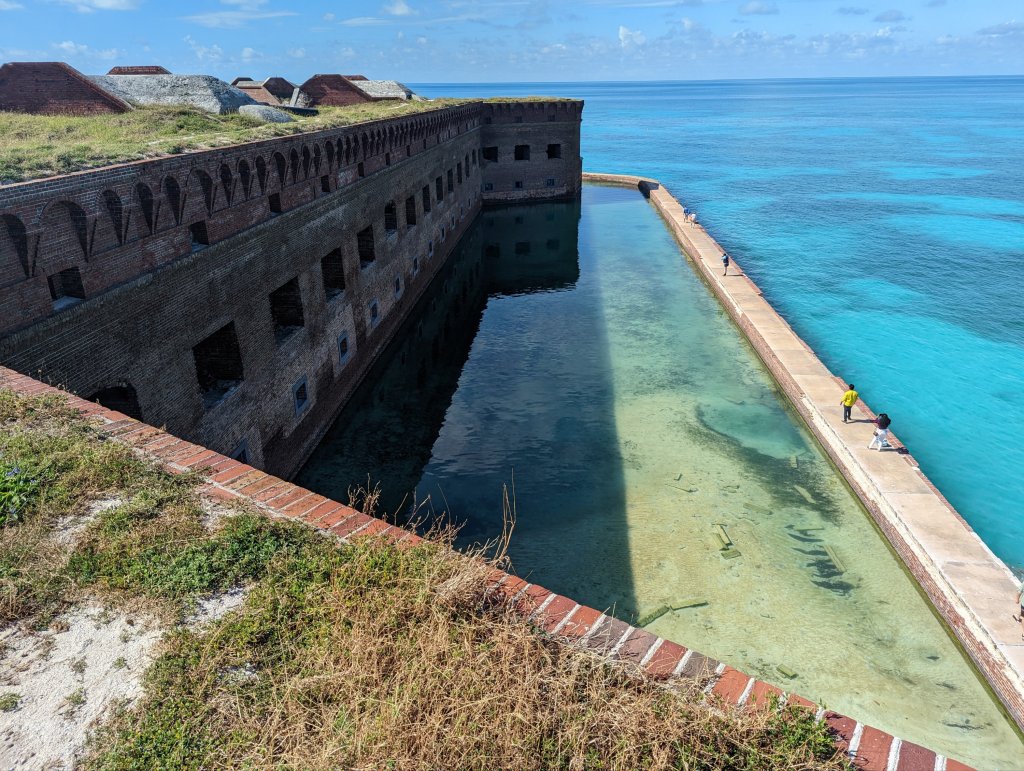
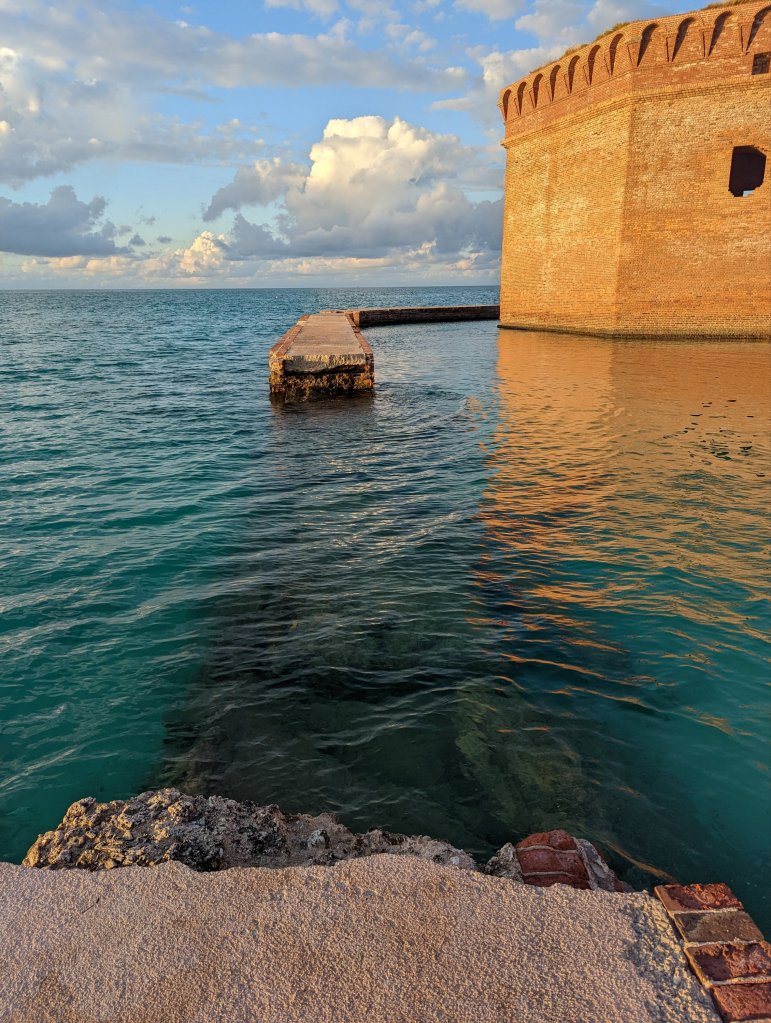
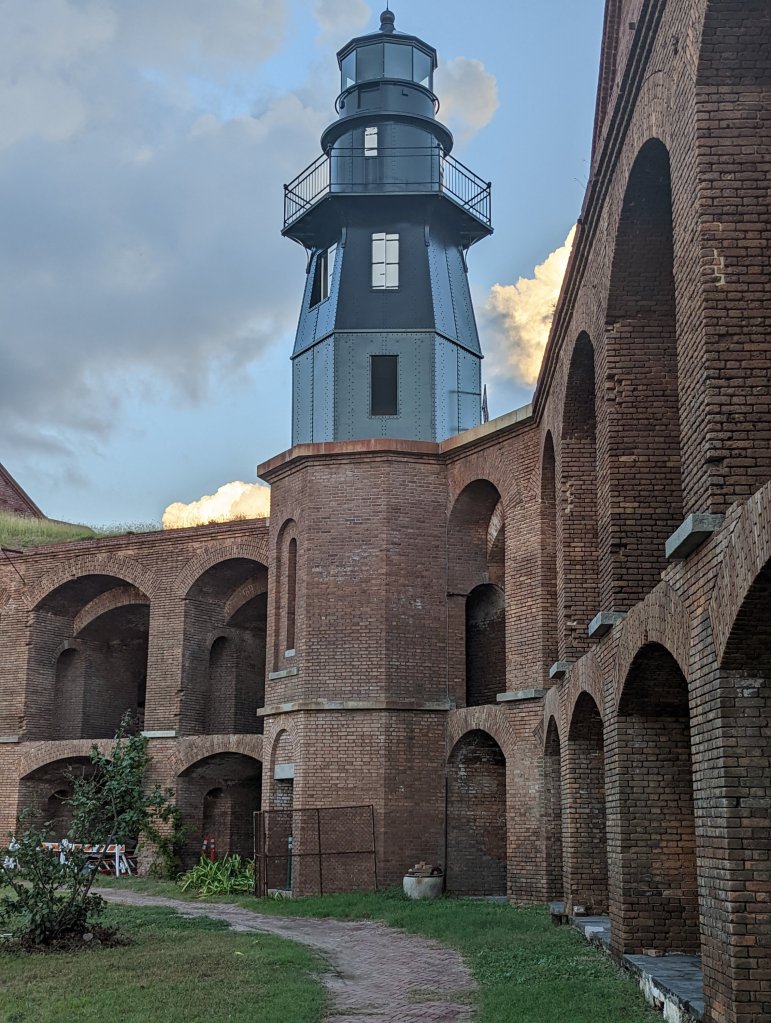
    Dry Tortugas is America’s smallest national park. It is basically a large hexagonal brick fort from the 1700’s. This expansive fort almost completely covers a small spit of sand poking out of the Gulf of Mexico. fort Jefferson was a naval outpost built to support ships patrolling the gulf during the “golden age of pirates” of the late 1700’s. It lies 70 miles due West from Key West–the furthest island in the chain of “keys” at the very tip of Florida. A ferry boat makes a daily run to Dry Tortugas and provides the only services available there. Reservations on this ferry must generally be made a year in advance.

    Along one side of the fortress walls there is a narrow strip of land you can camp on. After driving 2200 miles from Colorado (and dancing our way around hurricane Nicole) to get there, we camped and explored Dry Tortugas and a few neighboring keys for 3 fascinating days.

    The unusual history and sea kayaking were as wonderful as we’d hoped, but we hadn’t expected to see migrant boats arriving from Cuba. It was moving. Nothing will make you appreciate what you have more than seeing someone fling themselves down to kiss the sand after a daring 100 mile open water crossing in an overcrowded, rickety boat–just for a chance of having it also…